
Skin health
Skin as the proving ground for longevity medicine.
We focus on what can be seen and measured. Skin is where we test first, cosmetic and clinical alike.
Collagen loss, matrix breakdown, DNA damage, senescent cell burden. What shows on the outside is what we screen against in a living animal.
A clinical longevity endpoint takes decades to read. Skin reads in weeks, on tissue anyone can see and any lab can sample.
A cosmetic active can be on skin within a year or two of discovery. A topical drug takes far longer to reach a patient.
Radiation resilience and DNA-damage repair
Radiation and UV: a short timeline to a measurable result.
Ionizing radiation and UV damage skin through different lesions but overlapping pathways: oxidative stress, the DNA-damage response, and matrix loss.
Consumer: cosmetic photoaging
Botanical-derived actives selected for their effect on markers of skin aging in human skin cells after UV exposure. Intended for use alongside daily sun protection, not instead of it.
Mechanistic and cell-biology data are shared with partners under CDA.
Clinical: radiation dermatitis
Overlapping biology, different timescale. Radiotherapy delivers oxidative and DNA damage to the same skin cells over three to six weeks; photoaging takes decades. This is supportive care for a side effect of cancer treatment.
Our first clinical endpoint
A condition that affects most patients who receive breast radiotherapy.
Up to 95% of patients receiving breast radiotherapy develop acute radiation dermatitis (Salvo et al., Curr Oncol 2010). Grade 2 and above on the RTOG scale risks interrupting treatment. Fibrosis: EORTC 22881-10882 boost arm at 20-year follow-up (Bartelink et al., Lancet Oncol 2015). Guideline-recommended options are limited to prophylactic topical corticosteroids and barrier dressings; no topical drug is approved for treating established dermatitis (MASCC guidelines, Behroozian et al., 2023).
Patients report the effects reaching beyond the skin: worry, embarrassment, the ability to show affection, and the ability to work all worsen on patient-reported measures such as Skindex-16.
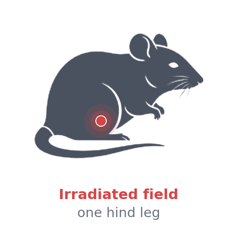
- 1
Irradiate
- 2
Post-irradiation
treatment - 3
Measure
Our clinical-track lead in a mouse model of radiation dermatitis
Applied topically after hind-limb irradiation, the lead reduced cumulative dermatitis burden relative to vehicle on two independent image-based measures calibrated to RTOG grades.
Best dose (10 µg/mL); cumulative burden as area under the curve, days 7–14, baseline-corrected. n = 3 per arm, preliminary; full dose series available to partners under CDA.
The measurement standard
How we measure.
Lifespan in C. elegans and DNA-damage response in human dermal fibroblasts, for both tracks. The clinical program adds tissue injury scored on the RTOG scale.
Ora does discovery and generates the evidence. Formulation and distribution are handled by partners.